
One of the Last Wood Sculptors in Desa Adat Batuan
In Desa Adat Batuan, wood carving has been part of daily life for generations. The patterns, techniques, and stories are usually passed down quietly from parent to child, often without being written down. Today, that tradition is slowly fading — and Anak Agung Raka Suana or we often called him Jungka is one of the last people still holding on to it.
Like many villages in Bali, Batuan has changed a lot over the years. The hospitality industry has become the most dominant source of income on the island. Working at a hotel, resort, or becoming a civil servant offers a stable salary, clear career paths, and long-term benefits like retirement. For young people who want security and a predictable future, those jobs make sense.
Wood carving, unfortunately, does not offer that kind of stability.
Jungka told us that orders for his work can be very unpredictable. Some months are busy, while others are completely quiet. In today's world, it's hard to rely on this kind of work if you're planning to raise a family. This uncertainty is one of the main reasons why fewer young people choose to become wood sculptors.
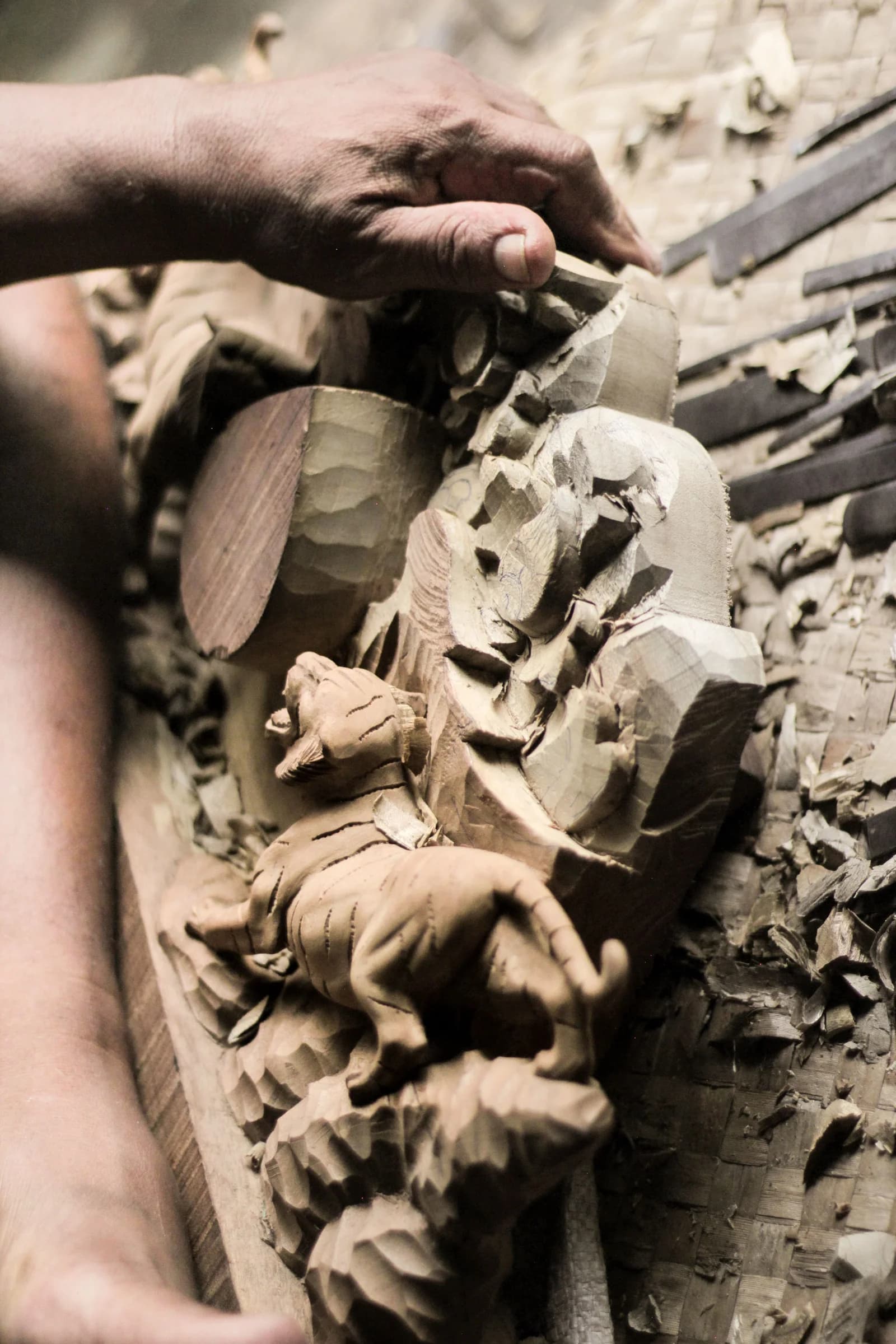
What makes Jungka's work special is his focus on wooden name plaque sculptures, which have become his personal signature. In Balinese wood carving, every craftsman usually develops a specific specialty. Some focus on wooden statues for decoration, others on wall panels, door carvings, mirrors, or furniture details. Each requires different techniques, tools, and years of practice.
Even though the final forms look different, all Balinese wood carving shares the same roots. The flowing patterns, layered depth, and symbolic motifs are inherited from generations before. These designs are not random — they are part of a visual language that reflects Balinese culture, beliefs, and way of life.
Passing down this knowledge is becoming more difficult. Because each craftsman specializes in different forms, the learning process is long and demanding. Without enough market demand, there is little motivation for the next generation to invest years mastering these skills.
Today, the biggest challenge facing Balinese wood carving is not the lack of talent, but the lack of opportunity. As demand decreases, so does the reason to continue the tradition. Slowly, quietly, an entire art form risks being forgotten.
At Balithings, we believe stories like Jungka's matter. Supporting artisans like him is not just about buying a product — it's about keeping a living tradition alive, one carving at a time.
Explore Related Products
Wood Carving
Hand-carved masterpieces from Balinese artisans using traditional techniques passed down through generations.
Browse Wood Carving